Sundar Pichai Announces India-America Subsea Connectivity Initiative
February 18, 2026 14:11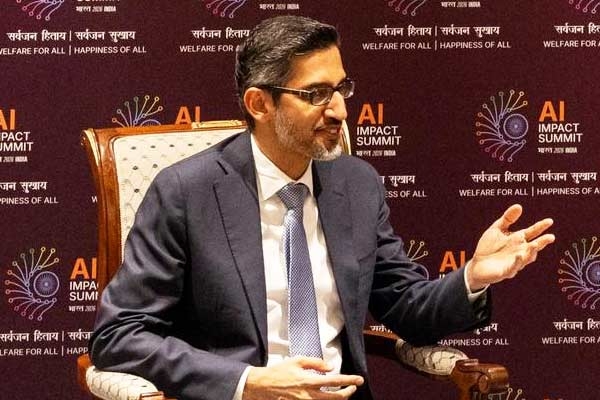
(Image source from: x.com/sundarpichai)
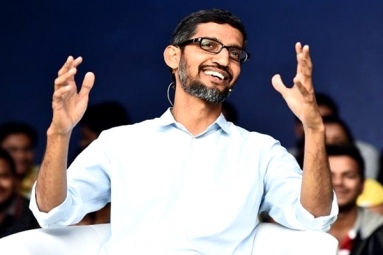
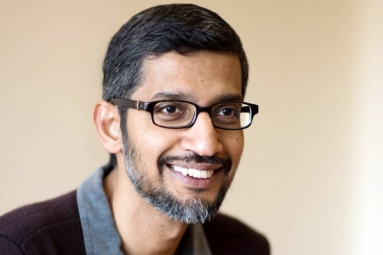
Google's CEO Sundar Pichai revealed on Wednesday the India-America Connect Initiative, which will introduce new underwater cable pathways to enhance AI connections between India and the US as well as several places in the southern hemisphere. “We are launching the India-America Connect Initiative, which will provide new underwater cable connections to boost AI links between India and the US and various areas in the southern hemisphere. To take advantage of the opportunities this initiative offers, we should also focus on skill development, which is why we are introducing our most comprehensive training programs here. This includes a new Google AI Professional Certificate program aimed at mastering AI in their jobs," stated CEO Sundar Pichai during a Google event in New Delhi. He further mentioned that India is on an "incredible path" in the field of artificial intelligence and highlighted the company's dedication to collaborating in India's AI growth.
“AI represents the largest technological shift of our era," Pichai explained, pointing out its ability to tackle problems on a large scale, such as enhancing healthcare assessments and aiding farmers with immediate notifications. He remarked that India’s diversity, language variety, and strong digital public systems create a "solid base for innovation" and a model for making AI accessible to everyone worldwide. Pichai insisted that adopting AI must focus on trust, safety, and inclusivity. “AI should function across different languages and local situations. It needs to provide tangible benefits that people can depend on. Trust builds when technology is clear, responsible, and outcomes are based on real results," he explained. The India-America Connect initiative is a global digital infrastructure project launched by Google to enhance high-capacity connections between India, the United States, and several regions in Africa, Asia-Pacific, and the Southern Hemisphere. Supported by Google’s planned $15 billion investment in AI infrastructure in India over five years, the initiative aims to improve network coverage, dependability, and resilience through new underwater cables, fibre-optic paths, and international landing points.
A significant aspect involves setting up a new international underwater gateway in Visakhapatnam, in addition to several underwater connections that will link India with Singapore, South Africa, and Australia, along with important land fiber routes connecting the US and India. This initiative aims to make India a key global center for connectivity while decreasing reliance on current cable landing sites like Mumbai and Chennai. “Working with local partners, America-India Connect will create a new international underwater gateway in Visakhapatnam (Vizag); three additional underwater pathways connecting India to Singapore, South Africa, and Australia; and four important fiber-optic routes that enhance the resilience and capacity of networks between the United States, India, and various spots in the Southern Hemisphere,” said Brian Quigley, VP, Global Network Infrastructure, Google Cloud, in a blog.
He mentioned that the company is building a direct fiber-optic route from Vizag to Chennai on India’s eastern coast leading to South Africa. When this is combined with the Equiano and Nuvem underwater cable systems, it will create a backup high-capacity route linking the US east coast around Africa to Vizag. Furthermore, there will be a direct link from Vizag to Singapore. When joined with the Bosun and Tabua underwater cable systems, this will form a South Pacific route connecting the US west coast via Australia to Vizag. “These investments will make Vizag a significant international underwater gateway, providing essential diversity from the current landings in Mumbai and Chennai. For a country with over 1 billion residents, this will enhance the strength of India’s digital infrastructure and boost economic stability,” Quigley explained.